

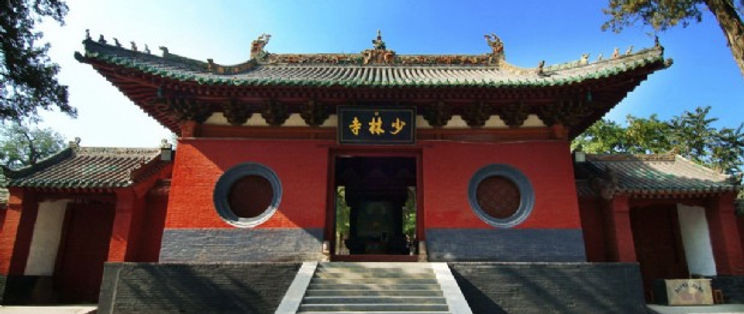
Shaolin Temple Lineage
1,500 Years of an Unbroken Tradition
Most martial arts schools teach technique. What gets passed down through the Shaolin Temple is something older and harder to define. It is a way of living, a complete philosophy of mind, body, and spirit. Chan, Wu, Yi. Transmitted unbroken from teacher to disciple across fifteen centuries and thirty-three generations. That lineage now lives and teaches in Wollongong.
The Birth of Shaolin, 495 AD
The Shaolin Temple was established in 495 AD at the foot of Song Mountain in Henan Province, China, by order of Emperor Xiaowen of the Northern Wei Dynasty. It was built to house the Indian monk Batuo (Buddhabhadra), who had travelled from India to teach Buddhist dharma. From the beginning, the temple sat at a crossroads of East and West, of philosophy and physicality, of stillness and movement.
The martial tradition took root a generation later, in 527 AD, when Bodhidharma (known in China as Damo) arrived at Shaolin. Finding the monks physically weakened by long periods of meditation, Damo is said to have introduced a set of physical and breathing exercises to restore and fortify them. From this synthesis of stillness and movement, Chan meditation and Kung Fu, the Shaolin arts were born. The two have never been separated since.
The Tang Dynasty (618 to 907 AD) marked the Temple's golden age. When thirteen Shaolin warrior monks helped rescue the future Emperor Li Shimin from a military siege in 621 AD, the emperor's gratitude elevated Shaolin's standing to a level no other monastery in China had reached. The temple thrived for centuries. At its peak in the Ming Dynasty (1368 to 1644), more than 3,000 monks trained within its walls.
The Temple has also endured great hardship. In 1928, a fire set by warlord Shi Yousan burned for over 40 days, destroying almost all of the temple's classical texts and records. It was an act of destruction that could have ended everything. It did not. The tradition held in human beings, not buildings.
The Three Treasures: Chan, Wu, Yi
Shaolin is not a fighting art with Buddhist trappings. It is a complete system for human development. Three pillars underpin everything taught at Shaolin, and everything taught here.
Chan (禅). Mind. The Zen Buddhist tradition of meditation, presence, and philosophical inquiry. Chan is not a separate practice. It is the ground from which everything else grows.
Wu (武). Martial. Kung Fu as a physical, technical, and energetic discipline. Not combat for its own sake, but the forging of character through the demands of the body.
Yi (醫). Medicine. The healing arts, including Qi Gong, Tai Chi Chuan, and the broader understanding of the body's energy system. What today we might call nervous system regulation. What the ancients called cultivating Qi.
These three do not exist in isolation. They are one system expressed through different modes. A student learns to fight, to breathe, to sit still, and to face themselves honestly. All four of those things are the same teaching.
The Dharma Name System: A Living Record of Lineage
In the 13th century, a monk named Xuětíng Fúyù (1203 to 1275) became Abbot of Shaolin during the early Yuan Dynasty and changed the temple's history permanently. Kublai Khan had sent him to restore Shaolin after a period of decline. He invited martial artists from across China to come, share, and refine their techniques in three separate symposiums, each lasting three years. The result was a codified Shaolin system that influenced virtually every Asian martial art that followed.
Fuyu also established the patriarchal clan naming system still in use today: the Dharma Name. This system is how the Shaolin lineage is tracked. Every ordained disciple and lay disciple receives a three-part name.
The first component is Shi, the Shaolin clan name, shared by all disciples worldwide. It derives from Shijiamouni (Shakyamuni Buddha), marking membership in the same extended family across centuries.
The second component is the generation name, drawn from a 70-character poem Fuyu composed specifically for this purpose. Each generation uses the next character in the poem. This is why a 30th generation disciple and a 33rd generation disciple carry different generation names. Their place in the poem is their place in history.
The third component is the personal name, given by the master to the disciple, reflecting traits the master has witnessed. Strength, leadership, a quality of character that the training has revealed.
My own Dharma name is Yong Lin-Dao, Eternal Spirit of the Way. Yong is the 33rd word in Fuyu's poem. I am a 33rd generation lay disciple. That is not a credential to put on a wall. It is a responsibility to pass something forward intact.
Venerable Abbot Shi Su Xi: The Root of This Lineage
The lineage Shaolin Warrior Martial Arts carries in Wollongong traces directly to Venerable Abbot and Grand Master Shi Su Xi (1924 to 2006), a 30th generation Shaolin monk and one of the last great masters of the elder generations.
Shi Su Xi was born in 1924 near Dengfeng, Henan Province, not far from the Shaolin Temple itself. He entered the temple at age eleven after losing both parents, and was ordained as a monk in 1937 under Master Zhenxu. He devoted seventy years of his life to Shaolin, enduring enormous hardship to preserve and carry the tradition through one of the most turbulent periods in Chinese history.
Among his disciples was Shi De Fon, a 31st generation disciple who trained at the Shaolin Temple before relocating to Sydney, Australia, where he taught traditional Shaolin Martial Arts to local students.
One of Shi De Fon's students in Sydney was Brett Russell, known within the Shaolin tradition as Xing Wu, a 32nd generation lay disciple certified to 4th Duan Wei in Shaolin Kung Fu by the Chinese Wushu Association in China.


How the Lineage Reaches Wollongong
One of Shi De Fon's students in Sydney was Brett Russell, known within the Shaolin tradition as Xing Wu, a 32nd generation lay disciple certified to 4th Duan Wei in Shaolin Kung Fu by the Chinese Wushu Association in China.
It was under Shifu Brett Russell that I trained in his Wǔguǎn (studio) located at Sydney suburd, Coogee. There I graded all the way to Level 6, and in 2015 received my Dharma name. Shortly after moving to Wollongong but continued training and grading through to level 16. The lineage from that moment is direct and unbroken.
Shi Su Xi (30th generation) to Shi De Fon (31st) to Xing Wu, Brett Russell (32nd) to Yong Ling Dao, Darrin Bird (33rd).
I have continued deepening my training since then, including time under Shi De Ru in the USA and Master Song in New Zealand, both masters within the broader Shaolin tradition. That ongoing study is part of what it means to be on this path. A teacher who stops learning has already stopped teaching.

Shifu Yong Lin-Dao: 33rd Generation, Wollongong
I am Shifu Darrin Bird, known within the Shaolin tradition as Yong Lin-Dao. I began Shaolin Kung Fu training at 46. Not a prodigy. Not someone who had been in a Wǔguǎn (martial school) since childhood. Someone who arrived at the practice later in life and found, to his genuine surprise, that it asked more of him than anything else he had done.
I founded Shaolin Warrior Martial Arts in Wollongong in 2018. I teach Shaolin Kung Fu, Tai Chi Chuan, and Qi Gong. The mission of this school is straightforward. To pass on what was entrusted to me, the teachings and tradition of Shaolin Martial Arts, as faithfully as I can. To preserve what Venerable Abbot Shi Su Xi spent a lifetime protecting.
What students find here is not a fitness class with Chinese aesthetics. It is the real thing.

"I have been looking for a traditional form of Shaolin Temple Kung Fu for a long time and was happy when I found Shifu Darrin. Every lesson is tailored and unique. Darrin concentrates on not only physical fitness but also mental wellbeing through Qi Gong."
Luke Donovan, student
"His teaching was comprehensive and thorough and he had such an abundance of knowledge about the history of Kung Fu and explained everything in detail."
Bède Armand, student
"I have participated in both Kung Fu and Tai Chi at Shaolin Warrior, and I love both for different reasons. Shaolin Martial Art is so much more than just the Kung Fu."
Crystal Hood, student
Amituofo !
Shifu Yong Ling Dao, Darrin Bird
33rd Generation Shaolin Lay Disciple
Head Instructor, Shaolin Warrior Martial Arts, Wollongong NSW
-
Shaolin Temple founding, 495 AD. Encyclopaedia Britannica: britannica.com/topic/Shaolin-Temple
-
Bodhidharma's arrival, 527 AD. American Martial Arts Institute / Dewushu: dewushu.com/blog/128041/History-of-the-Style-Shaolin
-
13 Shaolin monks and Emperor Li Shimin, approx. 621 AD. USA Shaolin Temple historical records and Shaolin Wushu Training Center: usashaolintemple.com; shaolinwushu.org
-
Shaolin at its peak, Ming Dynasty. Shaolin Temple Kung Fu Academy: shaolin-kungfu.net/shaolin-temple
-
1928 fire by warlord Shi Yousan. Shaolin Temple Kung Fu Academy: shaolin-kungfu.net/shaolin-temple
-
Abbot Xuětíng Fúyù (1203 to 1275), Dharma name system, 70-character generation poem. Wikipedia (Xueting Fuyu); Terebess.hu; USA Shaolin Temple Lineage page (usashaolintemple.com); Shaolin Monastery Historical Society (shaolin-monastery.blogspot.com).
-
Venerable Abbot Shi Su Xi (1924 to 2006), 30th generation. Wikipedia (Shi Suxi); Baidu Encyclopedia (English edition); Shaolin Chan City archival record (shaolinchancity.blogspot.com).
-
Shi De Fon, 31st generation disciple of Shi Su Xi. SWMA Student Handbook; shaolinwarrior.com.au
-
Shifu Brett Russell (Xing Wu), 32nd generation; Shifu Darrin Bird (Yong Ling Dao), 33rd generation, Dharma name received 2015, school founded 2018. SWMA Student Handbook; Warrior Path v3.0 document; shaolinwarrior.com.au
Page Last Updated: May 2026